
About Us

- NTS Dumfries and Galloway Countryside Team
- As members of the National Trust for Scotland Dumfries and Galloway Countryside Team, we manage properties across Dumfries and Galloway, including Threave Estate and Nature Reserve; Rockcliffe Property; Venniehill; The Murray's Isles and Bruce's Stone. Our task is to conserve and maintain the variety of habitats and species present, at the same time managing the sites for the education and enjoyment of current and future generations.
25 September 2012
Painted Lady and Sunshine

Osprey Update 25/9/2012
Our Osprey chicks are still showing well from the public viewing platform, but increasingly spending more time further away from the nest gaining strength in preparation for their migration. Our male black 80 was around over the weekend and seen bringing in a fish.
The good news we have an identity for our female Blue XC, Many Thanks go to Emyr Evans. We are awaiting more details on her and I will pass this information on as we receive it, yet another piece in the Threave Osprey story .......
The good news we have an identity for our female Blue XC, Many Thanks go to Emyr Evans. We are awaiting more details on her and I will pass this information on as we receive it, yet another piece in the Threave Osprey story .......
13 September 2012
Pastures New:
Hi everyone. My name is Paul and I have been the seasonal ranger with the Dumfries & Galloway countryside team since April this year and have been responsible for creating and updating this blog.
Having thoroughly enjoyed my time here working with such a great team, in such wonderful countryside, with such wonderful species and encountering all the very friendly visitors, I am off to pastures new. I have been lucky to have been offered a position working for the Wildlife Trust for Bedfordshire, Cambridgeshire & Northamptonshire.
So I just wanted to say goodbye and thank you to all who have followed the blog over the past few months and hope that you have enjoyed the few nuggets of info that I have offered up. The blog will be continuing with the help of Ranger Judy, Ranger Dave and Ranger Karl.
All the best.
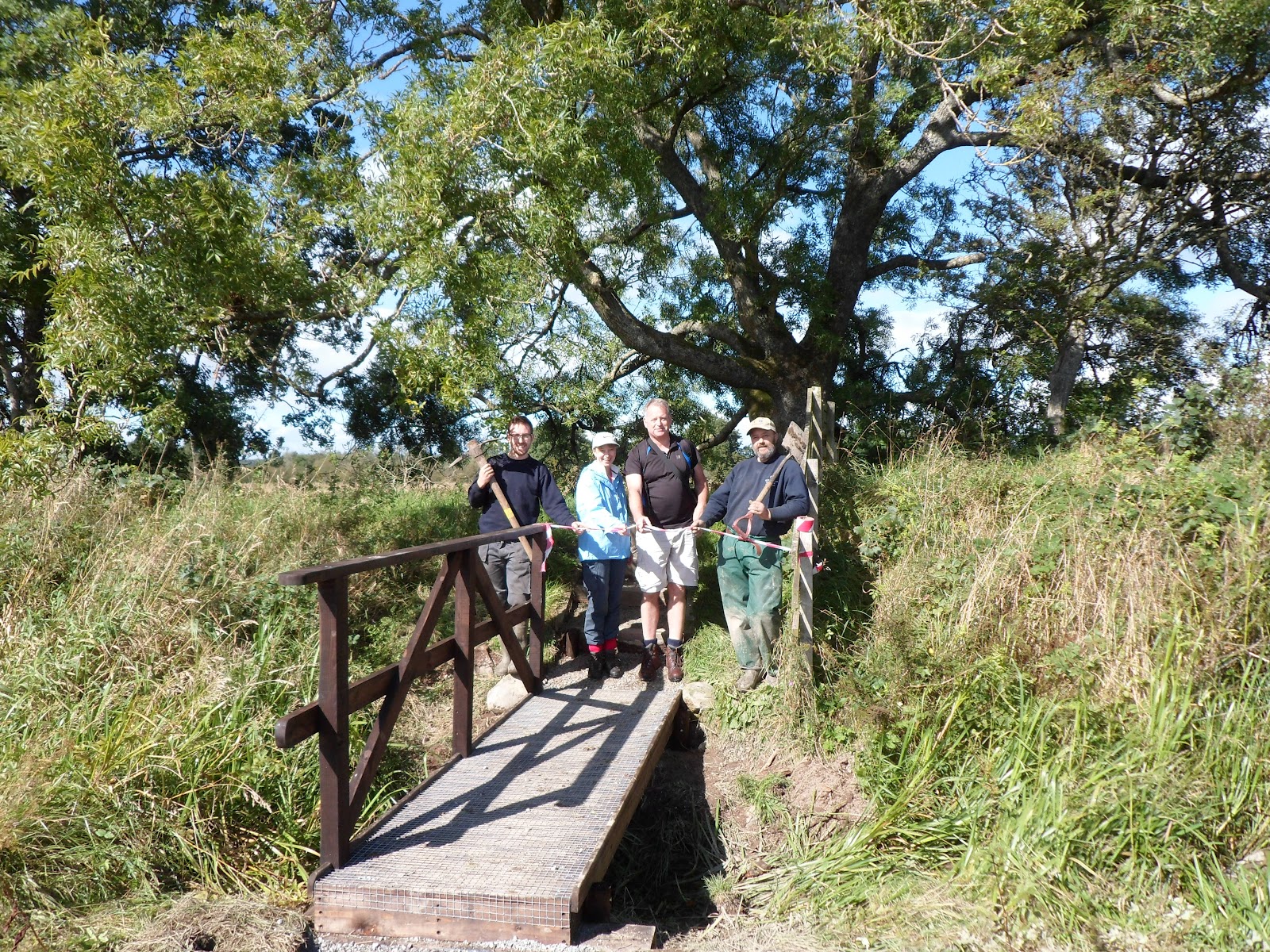
Building Bridges:
The ranger team, with the help of our volunteer Barry, have been busy constructing and installing a new bridge for the circular walk around the reserve on the Threave Estate.




06 September 2012
Osprey Update 06/09:
As of the 30/08/12 both chicks had fledged the nest. The second chick was a little less confident initially and could at times be seen calling to asking to be fed by the larger of the chicks rather than feed itself when the adults brought fish back. It was also seen more regularly at the nest. All four birds have been seen at the nest over the last few days although they are sitting at the nest less regularly and can often be seen in nearby trees.
29 August 2012
Osprey Update 29/08:
A CHICK HAS FLEDGED!
On Saturday 25th August one of the chicks was seen to leave the nest on what we believe to be his maiden flight. Since then there have been a number of sightings of one of the chicks flying around the area close to the nest. The second chick has not been seen as yet but must be ready any day now.
Unfortunately the path to the Osprey Platform has been inaccessible due to flooding, so we haven't been able to get any really good views of the birds over the past 2 days to see if the second chick has flown.
The camera which was placed on the nest will be removed once the birds have gone so as not to disturb them. Once we get the camera back we can hopefully fill in a few gaps in the females background and get some interesting shots of the ospreys behaviour at the nest over the past few weeks.
23 August 2012
Grayling Butterfly:
Ranger Judy got this nice photo of a grayling butterfly at our Rockcliffe reserve.

The colouring and pattern on the wings provide the grayling with perfect camouflage when resting on bare ground, tree trunks and rocks. They are most commonly seen around the coast but numbers are declining especially at inland sites. It prefers drier areas such as dunes, cliffs, heaths, old quarries and earthworks, with plenty of bare ground and sparse vegetation.
Sightings at Threave:
Here are just a few of the recent sightings recorded on the Threave nature reserve over the past 2 weeks:
Raven
kingfisher
Bullfinch feeding young
Elephant hawk moth caterpillar
Female marsh harrier
Redstart
Peregrine Falcon
Otters
Roe deer
Female hen harrier
Spotted flycatcher
Snipe
Lapwing
Greater spotted woodpecker
Barn owl
White throat
A flock of gold finch
Brown hare
Redpoll
A flock of greylag geese
16 August 2012
Thank You:
The team would like to thank all those volunteers from the Glasgow Conservation Volunteers Group for the work that they put in on the 11th & 12th August at our Rockcliffe reserve. The group helped out with our braken management and we got lots of work done. We would also like to thank the weather for staying nice over the 2 days.

09 August 2012
Osprey Update 09/08:
The story so far -
So just a quick recap for everyone to get you up to speed with what's happened so far this year. Our male osprey (Darvic ring Black80) arrived back on the 28th March. The female bird did not arrive back until the 11th May and was in fact a different bird to previous years. We were able to tell by the fact that the new female bird was ringed whereas the previous female was not ringed. The new female could be seen to have a blue Darvic ring on her leg but unfortunately we have not had a good enough view through a powerful scope to identify her yet. The arrival of the female on the 11th May was rather late as pretty much all of the other UK birds had arrived at their nests by mid April at the latest.
The birds showed signs that eggs had been laid around the 30/31 May. We believe the chicks hatched on the 5th July. Again these dates are very late as a result of the late return of the female. It is believed that these are the latest chicks to hatch in 2012. The week beginning the 16th July we had confirmation that there were two chicks in the nest and over the weeks since we have had more and more regular sightings of the chicks as they were being fed and as they were starting to grow and stretch their wings.
Osprey Chick Ringing -
On the evening of Tuesday 7th August we successfully ringed our two osprey chicks. The process involved climbing the tree in which the nest platform had been constructed.


The two chicks were then lowered to the ground where they could be ringed and weighed. The details are as follows:
Chick 1:
Darvic Ring - Blue/White CU3
BTO Ring - 1408278
Weight - 1.673 kg
Chick 2:
Darvic Ring - Blue/White CU4
BTO Ring - 1408279
Weight - 1.474 kg
We believe that both birds are males.
We believe that both birds are males.


Whilst the chicks were on the ground a camera was installed close to the nest to hopefully get some pictures of the females ring. This would enable us to find out her history and where she is from. If we don't get a clear shot of it then hopefully we will get some interesting shots of some of the chicks.
During the ringing both the male and female birds were seen to be keeping a good eye on the nest and by the time our volunteers got to the platform the next morning things looked pretty much back to normal.
During the ringing both the male and female birds were seen to be keeping a good eye on the nest and by the time our volunteers got to the platform the next morning things looked pretty much back to normal.
The chicks will hopefully fledge the nest around the 27th August.
Moth Trapping:
We recently undertook some moth trapping down at Kelton Mains on the Threave Reserve. Moth trapping is a useful way to study the diversity of moths in an area using non-lethal light traps. We also set the trap at our Rockcliffe reserve a week before. At Rockcliffe we managed to identify a total of 22 species.

At Threave we clocked up a rather small total of just 12 different species.
They were:
Antler
Burnished brass
Common footman
Common wainscot
Dark arches
Garden tiger
Large yellow underwing
Plain golden Y
Rosy rustic
Scalloped oak
Single dotted wave
Twin spot carpet
We believe a number of factors led to the low diversity of moths. The night we set the trap was very clear meaning that it was rather cool. Cool temperatures often lead to low moth activity. We were also competing with another light source as there was a full moon. The trap was also set close to the buildings at Kelton Mains where there is not much in the way of vegetation. Hopefully we will be setting the trap again on a warmer cloudier night in an area of the reserve which has a richer and more diverse vegetation cover.
They were:
Antler
Burnished brass
Common footman
Common wainscot
Dark arches
Garden tiger
Large yellow underwing
Plain golden Y
Rosy rustic
Scalloped oak
Single dotted wave
Twin spot carpet
We believe a number of factors led to the low diversity of moths. The night we set the trap was very clear meaning that it was rather cool. Cool temperatures often lead to low moth activity. We were also competing with another light source as there was a full moon. The trap was also set close to the buildings at Kelton Mains where there is not much in the way of vegetation. Hopefully we will be setting the trap again on a warmer cloudier night in an area of the reserve which has a richer and more diverse vegetation cover.

Burnished Brass

Rosy Rustic (above) Common Footman (below)

Garden Tiger

Subscribe to:
Posts (Atom)